
What to Take on Every Bike Ride: The Essential Cycling Kit
What should you carry on a bike ride? From puncture repair and tools to hydration, clothing and emergency essentials, here’s the kit worth taking every time.
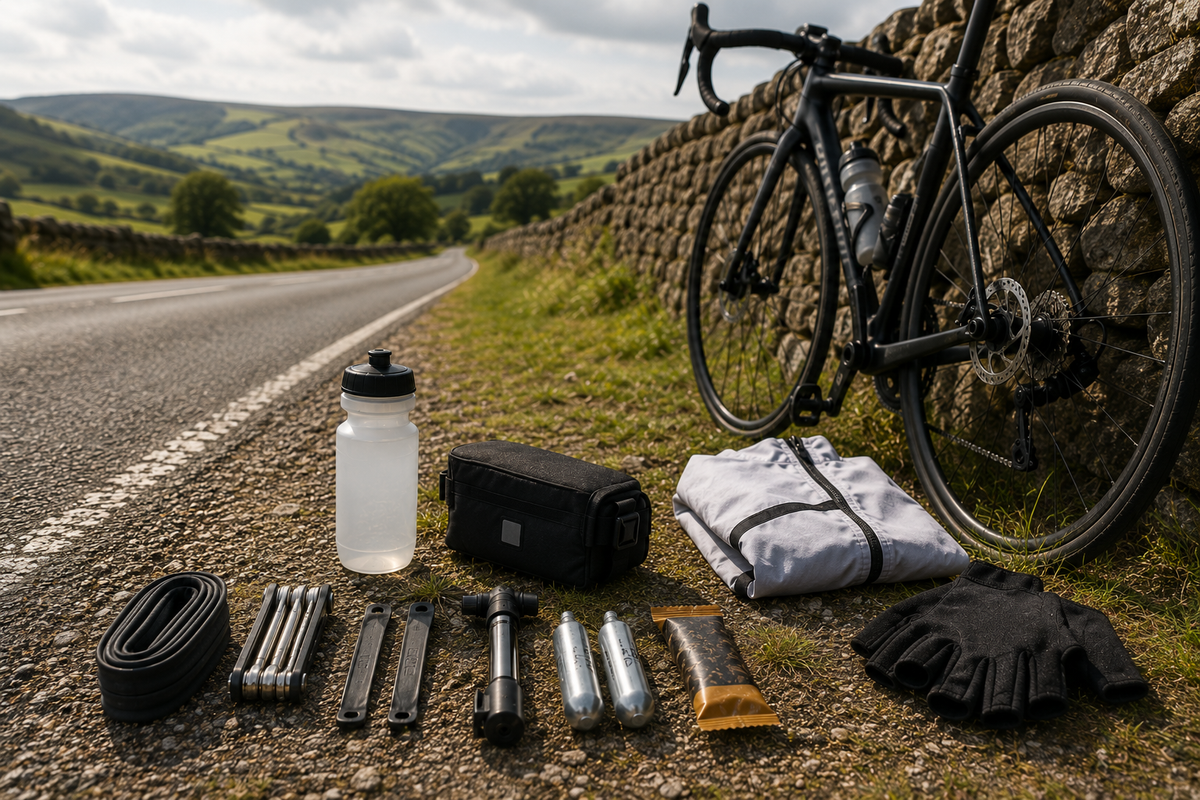
Most rides don't require much kit. But the few things you do carry can make the difference between fixing a problem in five minutes and standing at the side of a wet B-road wondering who might be willing to collect you.
For most everyday road and gravel rides, the essentials are simple: a way to repair a puncture, a way to inflate a tyre, a few basic tools, something to drink, enough food for the ride, a phone and appropriate clothing for the conditions. Go further, ride somewhere more remote or head out in unpredictable weather and the list grows accordingly.
The trick isn't carrying everything. It's carrying the right things for your bike, your route and the conditions.
The essential cycling kit checklist
If you want the short version, this is a sensible starting point for most rides:
- Spare inner tube, even if you run tubeless
- Tyre levers
- Mini pump
- Tubeless repair tool and plugs if you're running tubeless
- Compact multitool
- Correct quick link for your chain on longer or more remote rides
- Water
- Food for longer rides
- Mobile phone
- Bank card or another way to pay
- Identification and emergency contact information
- Front and rear lights if darkness is possible
- Packable layer or waterproof when conditions warrant it
- Any medication you may need
You don't necessarily need every item on every spin around the block. Think of this as the basis of a ride kit that you adapt rather than a packing list you follow blindly.
1. Start with the problem most likely to stop you: a puncture
Mechanical failures come in all shapes and sizes, but punctures remain one of the most common problems a cyclist can reasonably expect to deal with at the roadside. Cycling UK recommends carrying tyre levers, a replacement inner tube or patches and a pump.
What you need depends on your tyre setup.
If you use inner tubes
Carry at least:
- One spare tube
- Two tyre levers
- A mini pump
Make sure the tube actually fits your tyres and rims. Check the tyre width, wheel diameter and valve type, and make sure the valve is long enough if you're using deeper-section rims.
That sounds obvious, but the spare tube that's been sitting untouched in a saddle bag for two years isn't much use if it belongs to your previous bike.
For longer rides, a second tube or a small patch kit gives you another line of defence.
If you run tubeless
Tubeless doesn't mean puncture-proof.
Sealant can deal brilliantly with small holes without you doing anything more than noticing a brief spray from the tyre. A larger hole may need a tubeless plug. A damaged tyre, failed valve or puncture that refuses to seal can still leave you needing an inner tube.
A sensible tubeless repair setup therefore includes:
- Tubeless plug tool
- Suitable plugs
- Mini pump
- Spare inner tube
- Tyre levers, where appropriate for your tyre and rim combination
You may also choose to carry CO2 cartridges, but we wouldn't make CO2 your only means of inflation. Once a cartridge has been discharged, it's gone. A pump can keep trying.
Whatever system you use, learn how to use it before you need it. British Cycling makes the same point: carrying the right equipment doesn't help much if you've never practised fixing a flat.
Changing a tube at home with a cup of tea nearby is a much better introduction than learning beside a hedge in November.
2. Carry a multitool that actually fits your bike
A multitool is the other item that earns a permanent place in most ride kits.
You don't need a mobile workshop. You need enough to deal with the small problems that can otherwise end a ride: a slipping saddle, loose bottle cage, twisted lever or bolt that's worked itself loose.
Before buying or packing one, look at your bike.
Check which hex keys and Torx fittings it uses. Some modern components require fittings that aren't included on the smallest multitools. There's little value in carrying 18 functions if none of them fits the bolt that's come loose.
British Cycling recommends a multitool with the appropriate Allen keys, screwdriver and Torx heads for your bike.
For longer rides, we also like having a chain tool and the correct quick link for the chain fitted to the bike. A broken chain is much less common than a puncture, but a tiny quick link can turn a potentially terminal mechanical into a rideable bike.
Again, knowing how to use it matters.
3. Take enough water for the ride, not the photo
How much you need to drink varies enormously.
Temperature, humidity, effort, body size, ride duration and how much you personally sweat all matter. That's why rigid advice such as "drink one bottle every hour" isn't particularly useful for every rider in every situation.
For a short, easy ride in cool British weather, one bottle may be plenty. A long summer ride through exposed countryside is a completely different proposition.
Think about:
- How long you're likely to be out
- The forecast
- How hard you'll be riding
- Where you can refill
- Whether the route is remote
- Your own experience of how much you drink
On longer rides, plan refill points rather than simply loading the bike with enough water for an entire day.
And don't wait until you're miles from anywhere to discover that the village shop marked on an old route file closed three years ago.
4. Food becomes more important as the ride gets longer
You don't need to turn every 45-minute ride into a mobile buffet.
For shorter rides, you may not need to carry food at all. As distance, duration and intensity increase, having something easy to eat becomes increasingly useful.
That doesn't have to mean specialist sports nutrition. Depending on the ride and what agrees with you, it could be:
- Banana
- Flapjack
- Sandwich
- Dried fruit
- Energy bar
- Gel
- Sweets
- Something bought at the traditional cyclist's performance laboratory, otherwise known as a café
Cycling UK recommends carrying fluid and ride food, with options ranging from fruit and homemade snacks to energy products.
The important part is finding food you can comfortably eat while riding and remembering that a hard or long ride isn't the ideal time to experiment with something completely new.
For a bigger day out, carry an emergency snack beyond what you expect to eat. That final bar in the bag isn't part of lunch. It's insurance against a missed café, wrong turn or ride that takes much longer than planned.
5. Your phone is part of your ride kit
For many cyclists, the smartphone has quietly become one of the most useful pieces of equipment they carry.
It gives you:
- Emergency communication
- Navigation backup
- Access to weather information
- A way to pay
- A way to contact someone if the bike can't be repaired
Keep enough battery in reserve to make it useful.
If your phone is also running navigation for several hours, consider what happens if the battery runs low. Offline maps can also be valuable in places where mobile reception is poor. Cycling UK specifically recommends a phone, money, ID and navigation provision when appropriate.
We'd also recommend carrying some form of identification and making emergency contact information accessible from your phone's lock screen where your device allows it.
And while paying by phone is convenient, carrying a physical bank card takes almost no room and gives you a backup when your battery, signal or contactless payment doesn't cooperate.
6. Lights aren't just for planned night rides
If there's any realistic possibility you'll still be riding after sunset, take lights.
A puncture, mechanical problem, café stop or optimistic route choice can turn an afternoon ride into an evening one surprisingly quickly.
More importantly, this isn't simply about visibility.
In Great Britain, if you're cycling between sunset and sunrise, the Highway Code says your bike must have a white front light and red rear light illuminated. It must also have the required rear reflector and, where applicable, pedal reflectors.
Lights can also be useful during poor visibility in daytime conditions.
If you're heading out for a long autumn or winter ride, we'd rather have small lights on the bike and not need them than discover that "home before dark" was based on a very optimistic average speed.
7. Dress for what the weather might do next
British weather has a particular talent for making the clothing you chose at the front door feel ridiculous 90 minutes later.
Check the forecast, but also look at the route.
A sheltered local loop isn't the same as several hours over exposed hills. Likewise, a jacket that seems unnecessary while climbing can suddenly become very welcome after a mechanical stop or on a long descent.
Depending on the season, useful additions include:
- Lightweight waterproof jacket
- Packable gilet
- Arm warmers
- Gloves
- Neck warmer
- Extra insulating layer
Cycling UK includes a gilet, lightweight waterproof and adaptable warmers among its suggested day-ride clothing.
Packability matters. Good ride clothing earns its place by being useful when worn and unobtrusive when it isn't.
8. Carry the kit your particular bike needs
Generic checklists have a weakness: bikes aren't generic.
Your ideal repair kit should reflect what's actually fitted to yours.
Running tubeless? Carry plugs.
Deep rims? Check your spare tube has a sufficiently long valve.
Electronic gears? Know what happens when the battery gets low.
Using an unusual axle, fastener or component? Make sure your multitool can deal with it.
Going somewhere remote on a gravel bike? A tyre boot, extra plugs and quick link may make far more sense than they would for a 30-minute urban commute.
The best ride kit isn't the one with the most equipment. It's the smallest sensible collection of things capable of solving the problems your bike is reasonably likely to encounter.
9. Don't forget the things you can't fix with a multitool
Not every ride-ending problem is mechanical.
For longer or more remote rides, think about the rider as well as the bike.
That might mean carrying:
- Essential medication
- Sunscreen
- A small first-aid item or kit
- Emergency contact details
- Some cash
- A compact lock if you're planning stops
- A power bank on particularly long days
What belongs on that list depends heavily on the ride.
A four-hour solo gravel route across remote countryside deserves a different level of self-sufficiency from a club ride that passes a town every 20 minutes.
Where should you carry everything?
For a normal road ride, a small saddle bag plus jersey pockets will often be enough.
A compact tool or ride wallet can keep the smaller items together and stop a multitool, keys and bank card rattling around in a pocket. A top-tube or frame bag becomes useful when you want easier access to food or need more carrying capacity.
For bigger gravel and adventure rides, bar, frame and larger saddle bags give you substantially more room without putting everything on your back.
Cycling UK notes that most day-ride essentials can be carried using jersey pockets and a saddle, bar or frame bag, while a rucksack can become uncomfortable and sweaty.
Whichever system you choose, try to give frequently used items an obvious home. Food shouldn't require unpacking your entire repair kit at the roadside.
What should you take on a short bike ride?
For a short local ride, we'd keep it simple:
Phone, water when needed, puncture repair equipment, inflation and a basic multitool.
Add clothing, food and lights according to the conditions and time of day.
If you're only riding a few miles from home, your contingency plan might simply be calling someone or walking to a nearby station. That's perfectly reasonable. Self-sufficiency should be proportionate to the ride.
What should you take on a long bike ride?
As the distance grows, redundancy starts to matter.
For a long day ride we'd consider:
- Two spare tubes rather than one, particularly if using tubes
- Tubeless repair kit where applicable
- Pump, even if carrying CO2
- Multitool with chain tool
- Correct quick link
- Enough food plus an emergency reserve
- Adequate fluids and known refill points
- Adaptable clothing
- Front and rear lights
- Phone and payment card
- Identification and emergency details
- Route available offline or on a dedicated cycling computer
- Essential medication
- Additional repair items appropriate to the bike and route
You don't need to prepare for every imaginable failure. You do want enough resilience that one ordinary problem doesn't end the day.
What should you check before leaving?
The easiest roadside repair is the one you never have to make.
Before setting off, give the bike a quick check. Tyres should be in good condition and appropriately inflated. Wheels should be secure. Brakes should work correctly. The drivetrain should run properly. Look for anything loose, damaged or obviously worn.
Cycling UK recommends regular pre-ride checks and provides an M-check as a systematic way of inspecting the bike.
For a big event or particularly long ride, don't leave maintenance until the night before. Test any significant adjustment, new component or new tyre setup on a shorter ride first.
The RDE rule: carry what earns its place
It's easy to approach cycling kit in one of two ways: take almost nothing and hope for the best, or pack for an unsupported crossing of a continent every time you leave home.
Neither is particularly useful.
Start with puncture repair, inflation, basic tools, communication and whatever food, water and clothing the ride demands. Then adjust your kit as you learn what you actually use.
The aim isn't to carry more.
It's to make sure a puncture, change in weather or minor mechanical doesn't get to decide when the ride ends.
Ride prepared. Then forget about the kit and enjoy the ride.